

What to Look for in New Betting Sites Not on GamStop

New betting sites not on GamStop have less historical evidence behind them, so an initial assessment should concentrate on information available from launch. The operator should be identifiable, its licence should lead back to the same company, and withdrawal restrictions should be available before money is deposited.
Then comes the sportsbook itself. A new brand advertising 50 sports is less interesting than one showing sensible pricing across competitions people actually bet on. We compare several fixtures rather than using one favourable Premier League price as evidence for the entire book.
When reviewing a new non-GamStop betting site, our first pass covers:
- legal operator and licensing information;
- whether the bookmaker is genuinely new or another domain for an existing business;
- sportsbook supplier and trading setup where identifiable;
- overround across comparable markets;
- maximum withdrawal per transaction and over longer periods;
- credit-card, bank, e-wallet and crypto payment conditions;
- wagering, minimum odds and withdrawal restrictions attached to bonuses;
- KYC clauses that could affect the first cash-out.
A recent launch does not need to outperform established non-GamStop betting sites in every category. It does need a reason to exist beyond another domain and another welcome banner.
How to Tell if a Non-GamStop Betting Site Is Really New

A new domain is not the same thing as a new bookmaker.
International betting businesses can change domains, launch mirrors or put another front end on an existing sportsbook. A site appearing for the first time in 2026 may therefore sit on top of an operation that has already been accepting bets for several years.
We look at the company, brand and betting product together.
A genuinely new betting operator may have a recently established brand and a sportsbook that has only just gone live. Another valid type of recent launch is a new brand created by an established gambling group. It is still a recent bookmaker launch, but the existing company history should remain visible in the review.
A mirror site is different. If the same company, player account, terms and sportsbook sit behind a second URL, we do not treat it as a newly launched bookmaker simply because the domain is younger.
This distinction matters particularly when comparing recently launched non-GamStop bookmakers. A six-month-old brand operated by an experienced group gives us a different set of evidence from a six-month-old brand whose ownership cannot be traced beyond the current website.
Our review follows the evidence in this order:
- Identify the company named in the terms.
- Look for previous domains or earlier versions of the same brand.
- Match the stated licence to the operator.
- Identify the sportsbook supplier where possible.
- Read withdrawal and verification rules.
- Compare identical betting markets.
- Calculate the real turnover attached to the opening promotion.
- Check account currency and payment conditions.
A homepage claim such as “no KYC” is not proof that documents can never be requested. If the terms reserve the right to verify an account, that restriction is considered when we assess the bookmaker’s registration and withdrawal process.
Betting Licences Need to Match the Company
A betting site not on GamStop may display an overseas licence, but this only answers one question: which regulator, if any, supervises the operator under that jurisdiction.
It does not automatically establish permission to provide remote betting to customers in England, Scotland or Wales. The Gambling Commission states that an overseas business needs a Commission licence if it provides remote gambling facilities to consumers in Great Britain.
That is why “available from the UK”, “internationally licensed” and “licensed to serve Great Britain” should not be treated as interchangeable descriptions.
For a newly launched bookmaker, the company name, licence number and domain should make sense together. A regulator badge without an identifiable legal entity gives us much less to verify.
Sportsbook Software at New Non-GamStop Bookies
For a newly launched bookmaker, the betting brand is only one layer of the sportsbook we assess.
The engine underneath may come from an established B2B supplier handling odds feeds, event coverage, risk tools, live markets and parts of the interface. Digitain, Altenar, Delasport and BetB2B are examples of suppliers active in the sportsbook sector.
Knowing the provider is useful because a new bookmaker does not necessarily start with new betting technology. It may launch on software that has already handled large volumes of pre-match and live betting elsewhere.
That can explain why two unrelated-looking new bookies have similar market names, event trees or betslip behaviour.
It does not mean their odds and limits will be identical.
Altenar gives operators considerable control over markets, margins and limits. Digitain combines sportsbook technology with trading and risk-management tools. Delasport supplies sportsbook, odds-feed and trading products, while BetB2B provides sports and esports infrastructure that operators can configure around their own brand.
| Sportsbook supplier | What the software can tell us | What still needs checking |
|---|---|---|
| Digitain | Established sportsbook and risk-management infrastructure | Actual odds, markets, limits and account rules |
| Altenar | Configurable markets, margins and stake limits | Operator-level league and customer settings |
| Delasport | Sportsbook, odds-feed and trading/risk products | Pricing, withdrawals and promotions |
| BetB2B | Sports and esports platform with customisation | Markets, margins, limits and cashier conditions |
The supplier is a clue rather than a rating.
Two operators can run comparable technology and still offer different prices on the same Saturday afternoon fixture.
Sportsbook Software Does Not Determine the Odds
Suppose a two-outcome market is priced at 1.91 on each side.
Each price implies roughly 52.36%, so the combined implied probability is about 104.72%. That figure is the market’s overround.
At 1.95 and 1.95, the overround falls to approximately 102.56%.
The second market has a lower overround, which generally indicates more competitive pricing on that particular market.
The difference is also visible in cash terms. A £100 winning stake at 1.91 returns £191. The same result at 1.95 returns £195.
We would not rank a new sportsbook from one example. The same calculation should be repeated across several Premier League matches, another domestic competition and at least one live or lower-profile market.
A recognisable B2B engine tells us what the technology can support. The individual bookmaker determines the odds, limits and markets the customer actually sees.
Sports Coverage at New Non-GamStop Betting Sites
Sports coverage is another area where a recent launch can distinguish itself without putting hundreds of obscure sports in the menu.
Football is the obvious UK test. We look beyond 1X2 into Asian handicaps, cards, corners, team totals and player markets. Championship fixtures are useful because market depth often drops once a sportsbook moves below the Premier League.
Football requires a deeper comparison, particularly for Premier League and EFL market depth, in-play betting, player props and settlement rules. Bettors comparing football betting sites not on GamStop should pay more attention to those details than to the total number of football competitions displayed.
Horse racing follows different rules. Race count alone says little without each-way terms, non-runners, Rule 4 deductions and dead-heat settlement. For non-GamStop horse racing betting sites, those conditions are more revealing than the number of tracks shown in the daily schedule.
Rugby and Regional Tournament Coverage
A new sportsbook may cover the Six Nations heavily while offering much less on Premiership Rugby or the URC. Rugby league adds another layer through Super League and the NRL, so bettors comparing rugby betting not on GamStop should look at market depth and settlement rules across both codes rather than tournament availability alone.
Esports Markets and Settlement Rules
New sportsbooks can differ substantially in esports coverage even when their menus contain the same game names.
Counter-Strike 2, League of Legends and Dota 2 provide useful reference points. Match winner is only the start; map betting, handicaps, totals and in-play markets show how much of the product is actually available.
Settlement rules also deserve attention. A changed match format, abandoned map or substituted player can affect how a wager is settled.
For esports-focused bettors, market depth and settlement rules reveal more than the number of game titles in the menu. The same applies when comparing esports betting sites not on GamStop: a long event list is useful only when the underlying markets are substantial.
Live Betting at New Sportsbooks

Live betting is one of the quickest ways to see whether a recently launched sportsbook feels mature or unfinished.
Pre-match pages can look complete even on a modest betting product. In-play betting has to deal with constant suspensions, price movements and new event data.
We pay attention to how quickly common markets reopen after a significant event and whether a new price is clearly shown before the bet is confirmed.
Bet history matters too. An accepted wager should be easy to find while several live markets are open.
A new betting platform built on established B2B software may avoid some of the obvious technical problems associated with a completely new engine. Operator-level decisions around prices, market availability, limits and settlement still determine how useful the final sportsbook is.
Credit Cards at Non-GamStop Betting Sites

Payment setup is particularly useful when assessing a newly launched bookmaker because cashier rules can be checked immediately, even when long-term player feedback is limited.
Credit cards create one of the clearest differences between Gambling Commission licensees and some internationally operated betting sites.
Since April 2020, applicable Gambling Commission licensees have been prohibited from accepting credit-card payments for gambling. The restriction also extends to credit-card-funded payments routed through money service businesses such as e-wallets.
Some betting sites not on GamStop may show credit-card deposits because they operate under another payment and regulatory setup. That does not mean an overseas operator has permission to target British consumers. Accessibility from Great Britain and authorisation to provide remote gambling there remain separate issues.
When credit cards appear at a new bookmaker, we look beyond the Visa or Mastercard logo:
- whether credit and debit cards are distinguished;
- whether the account is funded directly in GBP;
- whether the processor applies a separate charge;
- whether the issuer can treat the payment differently from an ordinary purchase;
- whether the same payment route supports withdrawals.
Credit-card availability is therefore a payment difference, not evidence that a bookmaker is better regulated or safer to use.
Crypto Payments at New Bookies

Crypto is common enough among international betting sites that “Bitcoin accepted” or “USDT supported” tells us very little.
For a new bookmaker, the more useful questions are which network is supported, what happens when the deposit reaches the cashier and which network can be used when the balance is withdrawn.
USDT provides a simple example.
USD₮ exists on several blockchain networks, including ERC20 on Ethereum and TRC20 on Tron. A TRC20 deposit address and an ERC20 deposit address are not interchangeable simply because the asset is USDT in both cases.
For a bookmaker review, the practical sequence is more important:
network selected → amount sent → conversion applied → amount credited → withdrawal network → operator processing time.
This can expose costs that are not visible in a simple “0% deposit fee” claim.
Crypto Deposits into GBP Betting Accounts
A new sportsbook can accept USDT while displaying the betting balance in pounds.
If conversion happens automatically, we compare the amount sent with the GBP amount ultimately credited. A separate transaction fee is only one possible cost. The exchange rate used inside the cashier can introduce a spread even when the stated deposit fee is zero.
The same issue can appear on withdrawal.
A £1,000 sportsbook balance converted into USDT does not necessarily produce exactly £1,000 worth of tokens at a market reference rate once the operator or payment processor applies its own quote.
Blockchain confirmation time is also separate from bookmaker processing time. A withdrawal can remain pending inside the betting account before a transaction is sent to the network.
Individual coins and networks can be compared in more detail, but for a recent launch the immediate question is whether the cashier makes its conversion, withdrawal and network rules clear before money is sent.
Withdrawal Limits at New Betting Sites
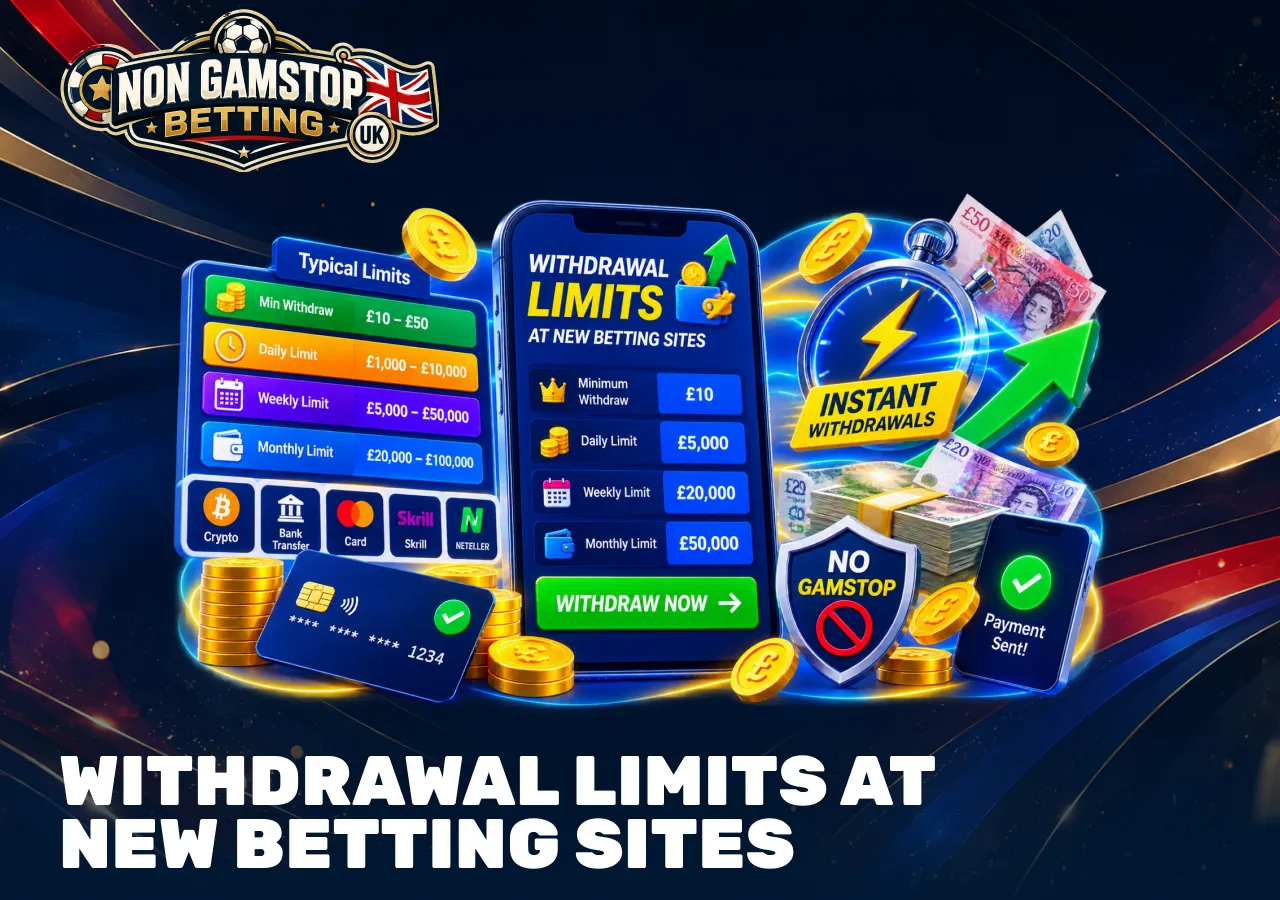
Withdrawal limits become more revealing as the balance grows.
Assume a new bookmaker permits £500 per transaction and £2,000 in withdrawals per week.
A £5,000 balance requires at least ten separate transactions and cannot be withdrawn within one week, no matter how quickly each approved payment reaches its destination.
That is why “fast withdrawals” is not enough for our comparison.
We want to know the per-transaction maximum, daily or weekly ceiling, any fees, available payout routes and internal pending rules.
For new betting sites without GamStop, published limits are especially useful because they show how difficult a larger balance may be to withdraw before the bettor reaches that point.
Bonuses at New Non-GamStop Betting Sites
The headline bonus matters less than the turnover required to clear it.
Take a hypothetical 100% bonus up to £200.
Deposit £200 and the promotional balance adds another £200.
If wagering is 8x the bonus, the qualifying turnover is £1,600.
If the same 8x applies to deposit plus bonus, required turnover doubles to £3,200.
The promotion can still display “100% up to £200” in both cases.
Minimum qualifying odds then change which bets contribute. Add maximum stake restrictions, expiry and a possible cap on converted winnings, and two bonuses with the same advertised value can work very differently.
This is particularly relevant to new betting bonuses because recent launches often use acquisition offers heavily during their first months.
We prefer a smaller promotion with clear, workable terms over a larger headline bonus that is difficult to convert into withdrawable funds.
Registration and KYC at New Bookies
Registration itself tells us relatively little. The important part is what can happen to the account later.
A newly launched betting site may allow an account to be opened without immediate document checks. That is not the same as a bookmaker where KYC can never be requested.
We read the terms for references to:
- proof of identity;
- proof of address;
- payment ownership;
- source-of-funds or enhanced checks;
- verification before withdrawal;
- account restrictions while documents are being reviewed.
This matters particularly around withdrawals. A user seeing “no KYC registration” on the homepage may reasonably understand that as a sign-up feature; it should not be expanded into a claim that documents will never be requested unless the terms genuinely support that statement.
Mobile Betting at Recent Sportsbook Launches
Recent sportsbook launches often start without years of legacy interface changes.
That does not automatically make the mobile product better.
We look at ordinary betting tasks: opening an event, adding selections, switching leagues, changing a stake and finding the accepted wager afterwards.
Live betting is a stronger mobile test than browsing a pre-match coupon because prices and availability are changing constantly.
We also distinguish between Android APKs, browser sportsbooks, PWAs and native iPhone applications. If a recently launched bookmaker advertises an app, we check what is actually being supplied instead of using “app” as a catch-all description.
New Bookies vs Established Non-GamStop Operators
The main difference between new and established non-GamStop bookmakers is not automatically quality. It is the type of evidence available.
| New bookmaker | Established operator |
| May use newer sportsbook integrations | Longer operating history |
| Launch promotions are common | More historical bonus records |
| Less public withdrawal history | More evidence around previous payouts |
| Newer interface is possible | More established account procedures |
| Fewer long-term complaint patterns | Recurring complaints are easier to identify |
| Current terms carry more weight | Past behaviour can be compared with current rules |
This is why recently launched bookmakers need to be assessed differently from established non-GamStop betting sites.
For bettors interested in newer bookmakers, the key question is what can actually be verified when an operator has not yet had years to build a public track record.
With a recent brand, company information, sportsbook technology, current odds, limits and cashier rules become central to the review.
With an older bookmaker, past behaviour can be added to the same evidence.
Neither age group receives an automatic advantage.
Responsible Gambling Outside GamStop
For bettors in Great Britain, the difference between betting sites outside GamStop and Gambling Commission licensees is not limited to payments or bonuses.
GamStop is the national multi-operator online self-exclusion scheme used within the Great Britain licensing framework. Relevant Gambling Commission remote licensees are required to participate.
An internationally operated bookmaker may provide its own account limits, cooling-off periods or site-level self-exclusion, but those controls need to be checked operator by operator.
Anyone who registered with GamStop in order to stop gambling should not treat betting sites without GamStop as a route around that exclusion.