

Start With Today’s Racecards

For a British racing bettor, domestic coverage is the foundation of the comparison.
A good non-GamStop racing site should carry more than the biggest televised events and include ordinary flat and jumps meetings throughout the week.
The schedule may include meetings from England, Scotland, Wales and Ireland, with markets appearing early enough to compare prices before the off. The programme changes every day, so a bookmaker’s claim to cover “all UK racing” is less useful than looking at the actual racecards.
A good horse racing sportsbook should let users move from today’s cards to tomorrow’s meetings without working through several unrelated menus. Runner names, odds, off times and the main betting options should remain easy to read as a race approaches.
This is a more useful starting point than the total number of sports shown elsewhere on the site.
Ordinary Meetings Tell You More Than Festival Week
Major meetings still provide a useful test.
Cheltenham can show the depth of ante-post markets and extra-place promotions. The Grand National puts more emphasis on large fields and each-way terms, while Royal Ascot provides a similar comparison on the flat.
Regular coverage matters just as much.
A bookmaker can handle the major festivals well and still provide a fairly limited racing product for the rest of the season.
Festival weeks often bring additional ante-post markets, enhanced places or special prices. These additions are worth considering, but they should not disguise weak coverage on ordinary race days.
A large racing bonus means little if the race, market or bet type you want is excluded.
International Racing Comes After UK and Ireland
Some offshore racing sections also carry meetings from France, the United States, Australia, South Africa and other established racing markets.
The number of countries alone is a poor measure of depth.
One site may list an overseas race but offer little beyond the win market, while another may add place, each-way, forecast and further runner markets.
International racing is therefore a secondary criterion for a UK-focused page. British and Irish coverage should carry more weight unless the bettor specifically follows overseas racing.
What to Check Before Picking a Horse
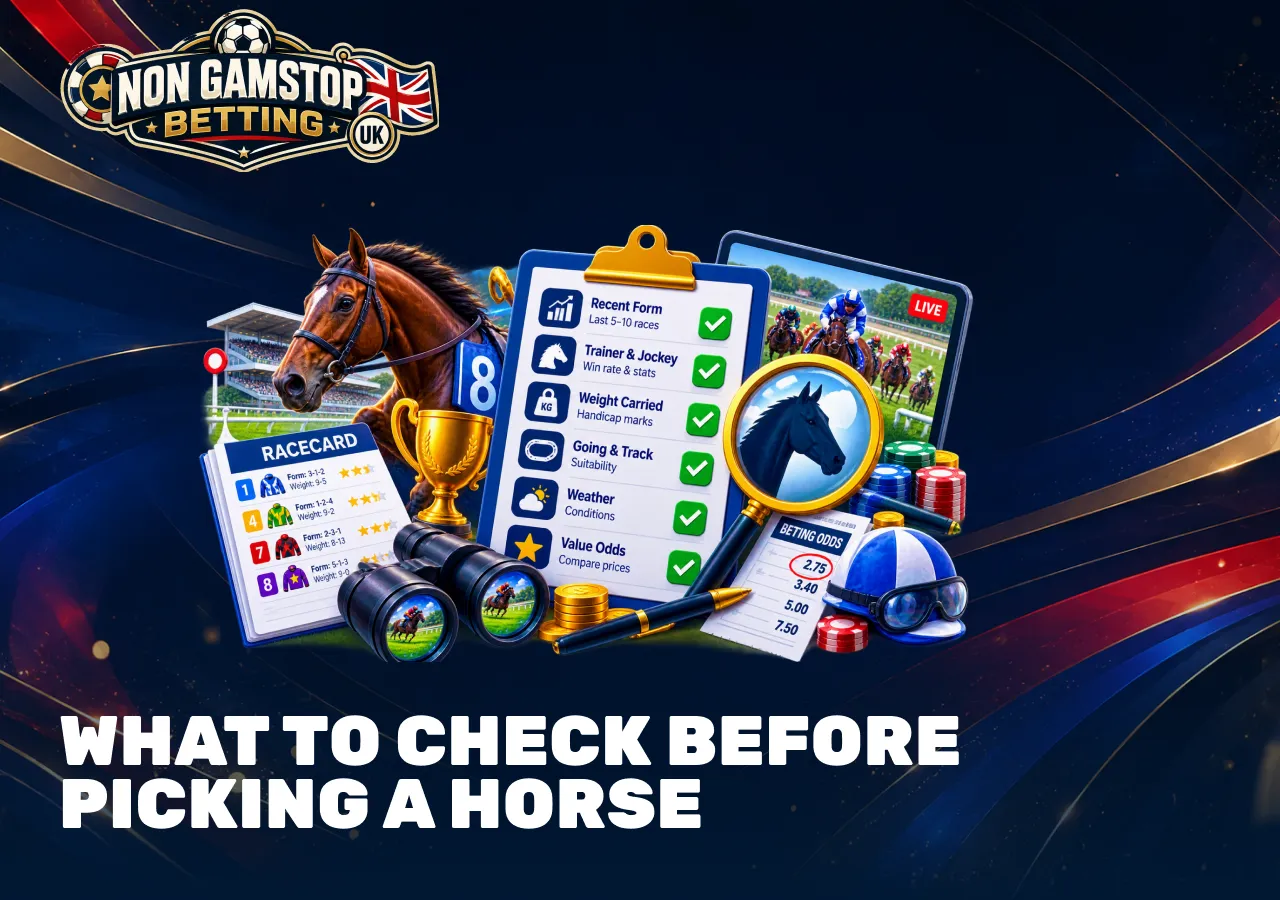
The sites in our comparison are judged primarily on the quality of their horse racing product rather than the total number of sports or markets advertised by the sportsbook.
A good racing section should make regular UK and Irish meetings easy to find, show the relevant each-way terms clearly and provide enough market depth to compare a simple win bet with ante-post, forecast and other racing options.
Major festivals are only part of that assessment.
Cheltenham, the Grand National and Royal Ascot are easy events for a bookmaker to put front and centre. A midweek card at an ordinary meeting tells you more about the everyday racing product: how many races are priced, how early markets appear and whether the choice extends beyond simple win betting.
Odds also need to be judged in context.
A bookmaker may be shorter on one horse and offer a better price on another. One attractive quote on its own says little about the general quality of the racing book.
| Area | What to look for |
|---|---|
| UK & Irish racing | Regular daily cards, not only major festivals |
| Each-way betting | Number of places, fraction and settlement terms |
| Ante-post | Early prices on major future races |
| Racing promotions | Extra places, odds boosts, free bets or refunds |
| Settlement rules | Non-runners, Rule 4, dead heats and abandoned races |
| Live betting | Markets available close to or during a race |
| Streaming | Race video and the conditions attached to access |
| Cash-out | Availability before the off and market restrictions |
| Withdrawals | Minimum withdrawal, methods and account currency |
| Mobile betting | Racecard usability and visibility of each-way terms |
| Operator details | Licence, KYC rules and complaint procedures |
A long list of other sports means little if the racing section itself is weak. Non-GamStop horse racing betting sites need to work as horse racing bookmakers first.
Win Price Is Only Part of an Each-Way Bet

A serious racing sportsbook needs more than a list of runners and decimal odds.
Market structure is one of the clearest differences between a proper racing product and a generic sports betting site not on GamStop.
Win, Place and Each-Way
A win bet requires the selected horse to finish first.
A place bet pays when the horse finishes in one of the positions covered by that particular market.
An each-way bet consists of two stakes: one on the horse to win and another on it to place.
The return on the place part depends on both the number of paid places and the fraction of the win odds.
This means the each-way terms can be just as important as the headline price.
Two bookmakers may quote the same odds for a horse to win but offer very different terms on the place part.
One might pay four places at one-fifth of the odds, while another may temporarily extend the race to five places under an enhanced-place promotion.
Field size can also change the terms, particularly in handicaps and large festival races.
Before confirming an each-way bet, check:
- number of places;
- place fraction;
- current field size;
- whether enhanced terms are permanent or promotional.
If that information is difficult to find before placing the bet, the displayed win price only tells part of the story.
Ante-Post Betting Is a Different Type of Racing Bet
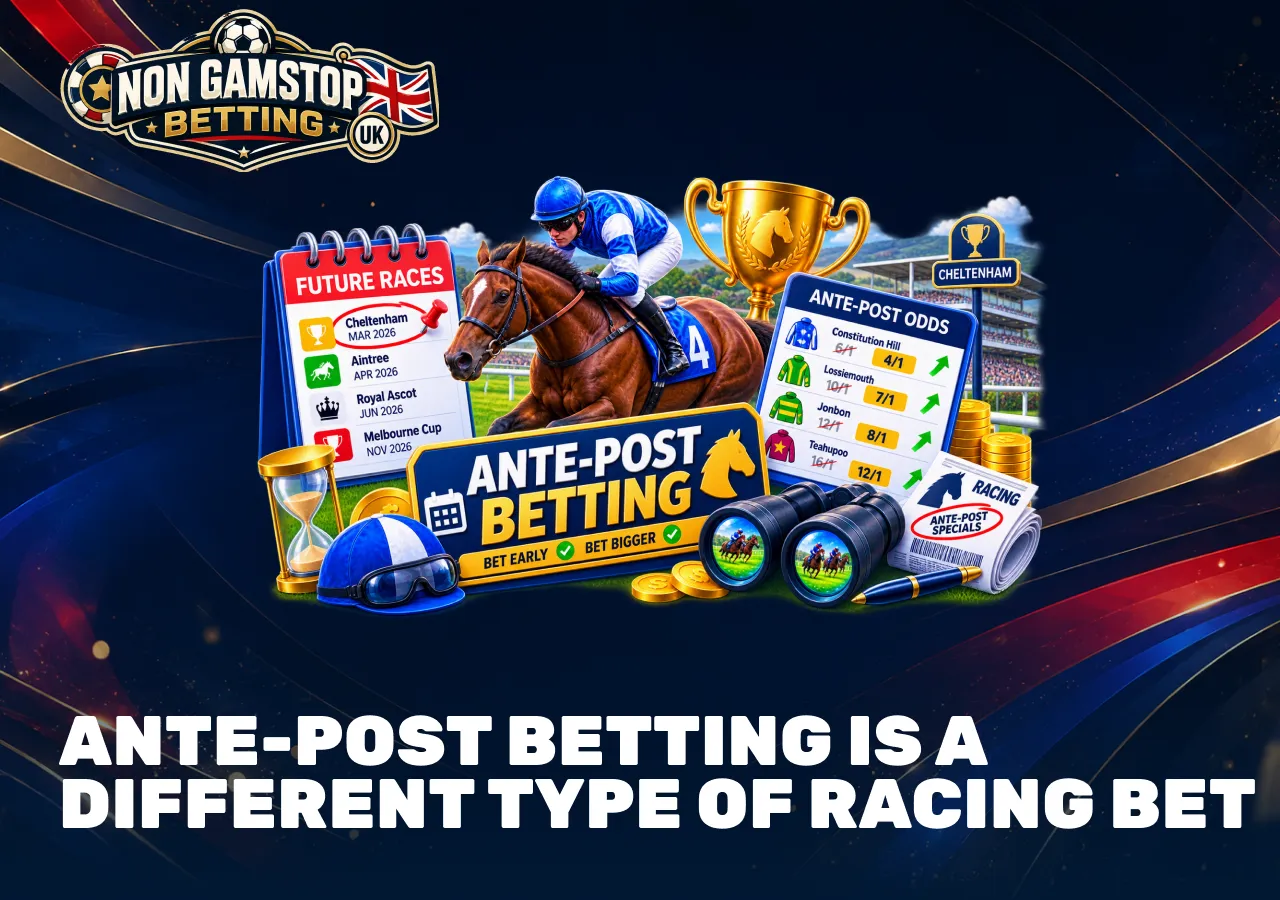
Ante-post markets open before final declarations and may appear weeks or months before major races.
They allow bettors to take an early position on a future event instead of waiting for the final field.
The trade-off lies in the settlement rules.
Under standard ante-post terms, a selected horse that later does not run may still result in a losing bet.
Some events or promotions are instead offered on Non-Runner No Bet terms.
That distinction matters more than the early price alone.
Check:
- when the market opened;
- which meetings receive ante-post coverage;
- whether NRNB applies;
- what happens if the selected horse is withdrawn.
Ante-post betting also makes payout limits more relevant because a bet may remain open for months before the event takes place.
Forecasts, Tricasts and Racing Accumulators
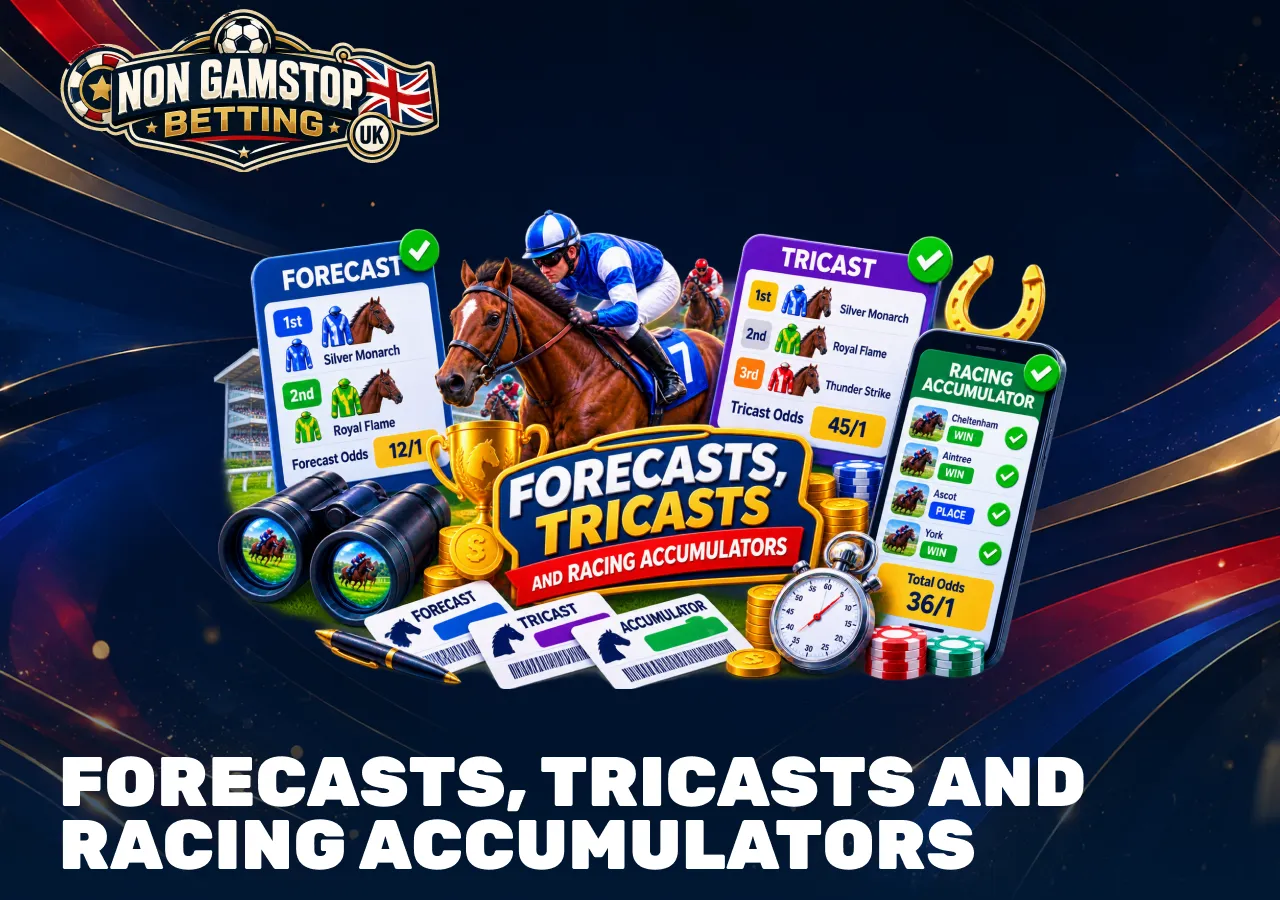
Not every racing bettor uses these markets, but they show how far the racing section extends beyond straightforward win and each-way betting.
Forecasts and Tricasts
A forecast involves predicting the first two finishers.
A Straight Forecast requires them to finish in the exact order selected, while a Reverse Forecast covers either finishing order.
A Tricast extends the same idea to the first three finishers.
These bets are not available on every race and can depend on field size or the bookmaker’s specific rules.
Forecasts and Tricasts should not carry the same weight as daily coverage or each-way terms, but their presence shows that the racing section goes beyond the most basic markets.
Horse Racing Accumulators
A racing accumulator combines selections from several races into one bet.
In a standard accumulator, every leg must win for the bet to return a payout.
The main issue is often promotional eligibility rather than the mechanics of the bet itself.
Minimum odds may apply to each leg, and certain markets or bonus funds may be excluded.
Racing promotions should therefore be read alongside the betting rules rather than judged only by the size of the advertised offer.
When the Field Changes After You Bet

Horse racing settlement rules rarely receive as much attention as bonuses or odds, even though they can directly affect the final return.
This is especially important because the final field can change after a bet has already been placed.
Non-Runners and Rule 4
A withdrawal can change both the market and the value of bets that have already been placed.
For ordinary fixed-odds horse racing bets, the withdrawal of the selected horse may result in the stake being returned under the bookmaker’s rules.
If another runner is withdrawn after prices have been formed, Rule 4 may reduce winnings on the remaining selections to reflect the changed market.
The size of a Rule 4 deduction depends on the withdrawn horse’s price and the rules applied by the bookmaker.
A good racing site should explain these deductions clearly enough that the bettor does not have to search through general terms after settlement.
Ante-post betting works differently.
A non-runner may still mean a losing bet unless the market was specifically offered as Non-Runner No Bet.
Reduced Fields and Each-Way Terms
Withdrawals can reduce the field enough to change the normal each-way terms.
A race may originally have paid four places, for example, but after several withdrawals it may no longer meet the required field-size condition.
Enhanced-place promotions can have separate rules of their own.
The final field therefore matters even if your selected horse is still running.
Dead Heats
A dead heat occurs when two or more runners cannot be separated for a finishing position.
The stake and winnings may then be divided according to the number of horses tied and the number of available positions.
The exact calculation depends on the type of bet and market.
This is particularly important for place markets and each-way bets.
A bookmaker that explains its dead-heat rules clearly is easier to assess than one that relies on a vague general settlement clause.
Abandoned and Postponed Races
An abandoned meeting does not always mean every bet is immediately void.
The result can depend on whether the race is rescheduled, how soon it is run and what the bookmaker’s terms say about postponements.
The same applies when a race starts but is later officially declared void.
The rules may be relatively simple for ordinary win bets, but accumulators, ante-post bets and promotions can introduce additional conditions.
This is another reason to read the racing rules before relying on a large promotional balance.
Racing Promotions Need to Be Judged Race by Race

Horse racing offers are worth comparing separately from a general sportsbook welcome bonus.
Extra places, enhanced odds or a usable free bet may matter more to a regular racing bettor than a larger offer with restrictive qualifying conditions.
Extra Places and Best Odds Guaranteed
Extra-place promotions are especially useful in large fields.
A standard market may pay four places, while a promotion extends this to five or six under specific race, odds or stake conditions.
Best Odds Guaranteed, usually shortened to BOG, concerns the difference between an early price and the Starting Price.
An early price is the odds available when the bet is placed before the race.
The Starting Price is intended to reflect the market price available at the off and is confirmed shortly afterwards.
Where BOG applies, an eligible bet may be settled using the better qualifying price under the bookmaker’s rules.
BOG should not be treated as a standard feature of horse racing betting sites not on GamStop.
Eligible races, bet types and settlement conditions vary, and some bookmakers do not offer BOG at all.
Free Bets, Odds Boosts and Welcome Offers
Other horse racing promotions may include:
- free bets on selected races;
- enhanced prices on individual runners;
- money-back offers;
- festival promotions;
- accumulator deals involving racing selections.
The advertised amount is only one part of the offer.
Minimum odds, maximum qualifying stakes, expiry periods and excluded markets can change its practical value considerably.
The same applies to welcome bonuses.
Some sportsbook offers allow horse racing, while others exclude ante-post bets, certain each-way selections or other markets.
A smaller offer with clear racing terms can be more useful than a larger bonus that excludes the bets you actually use.
The Final Minutes Before the Off
Live features can add something to a racing sportsbook, but their availability varies more than it does in many team sports.
Some horse racing betting sites not on GamStop keep selected markets open close to the start, while certain races may have in-play options.
Horse racing moves quickly, so the betting window can be short.
Streaming
Streaming is a separate feature.
A bookmaker may provide race video only after a qualifying bet or under specific account conditions.
Another site may offer live data or commentary without a video stream.
The useful checks are specific:
- which meetings are available to stream;
- whether a minimum stake is required;
- whether video works on mobile;
- when access to the stream becomes available.
Cash Out
Cash-out also depends on the individual bet.
Ante-post wagers, promotional bets and fast-moving markets may not support it.
The presence of a cash-out button somewhere in the sportsbook therefore does not mean it will be available for the horse racing bets you actually place.
A Racecard Is Also the Best Mobile Test
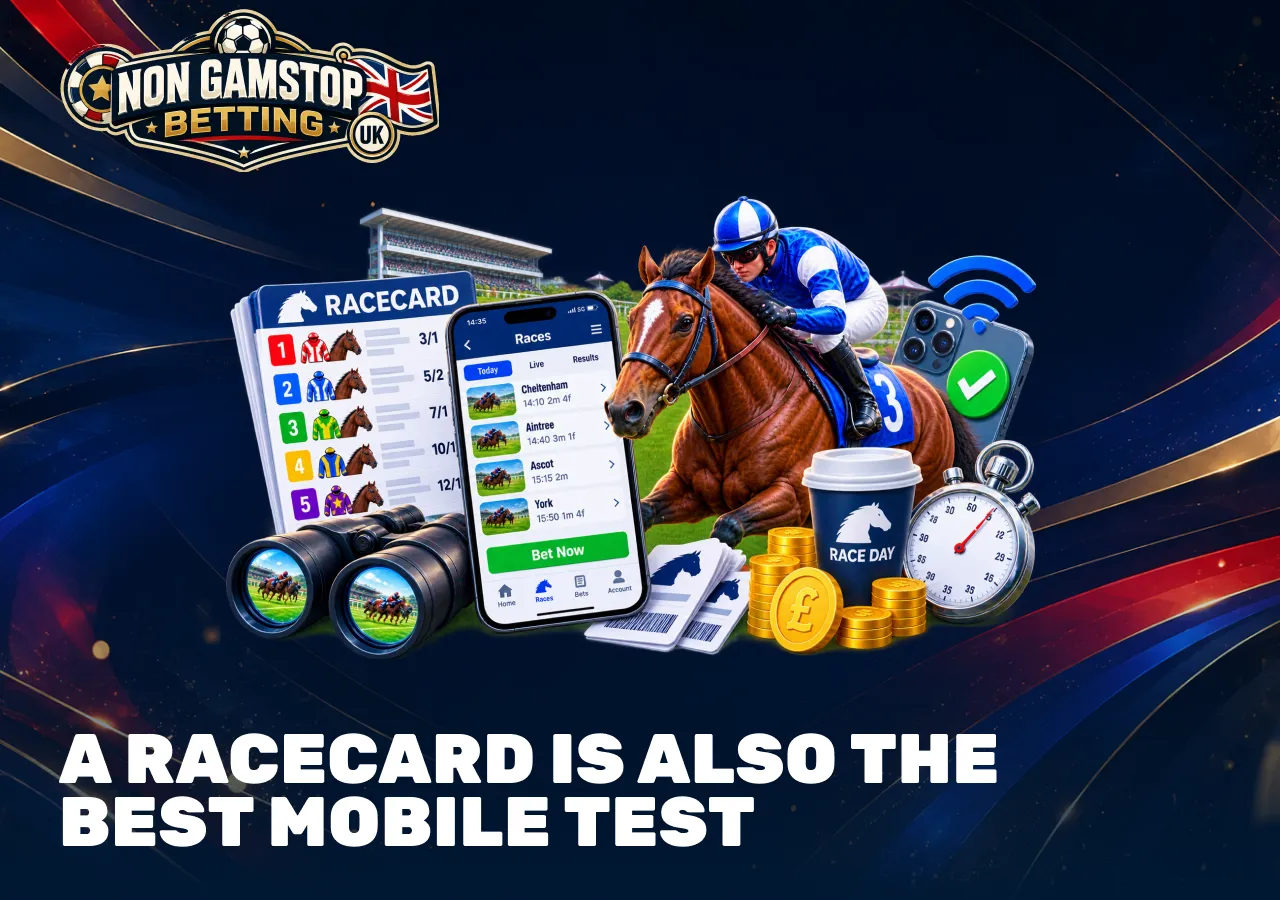
Horse racing creates a specific mobile problem: a lot of information needs to remain readable on a small screen while odds may be moving quickly.
A good mobile racing interface should keep the off time, runner name and odds visible without forcing the user through several additional panels.
The number of each-way places and the applicable fraction should also be available before the bet is confirmed.
The racecard is a better test than generic claims about the quality of an app.
Useful things to check include:
- how quickly today’s and tomorrow’s meetings can be reached;
- whether win and each-way selections are clearly separated;
- whether place terms remain visible in the bet slip;
- whether cash-out and streaming can be reached from the race page;
- whether the racing context is preserved when switching between meetings.
A native app is not automatically better than a mobile website.
For a racing bettor, the quality of the racecard and bet slip matters more than the icon used to open them.
Payout Limits Can Matter More Than Stake Limits
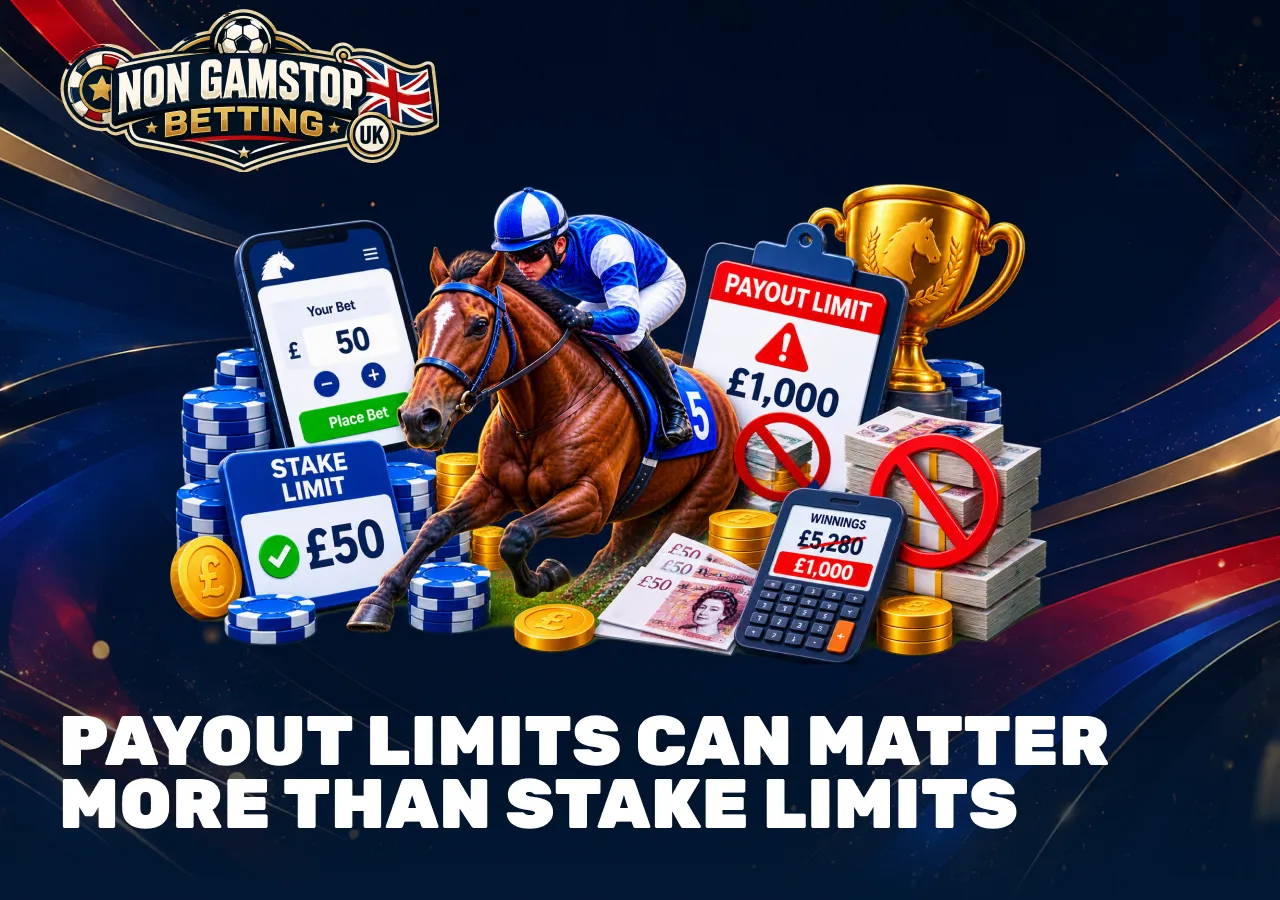
For a horse racing bettor, the maximum payout can matter more than the maximum stake shown in the bet slip.
A bookmaker may apply separate payout caps to horse racing, accumulators, ante-post markets or particular events.
Limits can also vary by account, currency or bet type.
This is particularly relevant for:
- accumulators with large combined odds;
- ante-post bets placed months before an event;
- higher-stake bettors;
- festival races with large fields;
- bets placed at enhanced or promotional prices.
A maximum payout should not be confused with a maximum stake.
A site may accept a relatively large stake while still limiting the amount it will pay out on the resulting bet.
If the terms contain separate racing limits, those are more relevant here than a generic sportsbook maximum.
Check the Cashier Before Leaving a Balance
Payments matter in the comparison, but there is no reason to turn a horse racing page into a full cashier guide.
The main checks are simple:
- whether GBP accounts are available;
- minimum deposit;
- minimum withdrawal;
- whether the deposit method can also receive withdrawals;
- whether fees are shown before the transaction;
- which identity checks may affect a withdrawal.
A method available for deposits should not automatically be assumed to work for withdrawals.
The lists can differ.
Withdrawal speed also needs to be treated carefully.
The payment network itself may support fast transfers, while bookmaker processing or verification adds extra time.
Some overseas sites also accept cryptocurrency.
If that matters, check which assets are supported, whether withdrawals are returned in the same currency, how conversion is handled and whether separate transaction minimums apply.
The presence of Bitcoin or USDT says nothing about the quality of the horse racing section.
Operator Checks Are Separate From Racing Quality
No offshore bookmaker should be described as safe simply because a licence logo appears in the footer.
For horse racing bookies not on GamStop, check:
- legal operator name;
- licence details;
- terms;
- identity-verification rules;
- complaint procedure.
A regulatory logo is only useful if the underlying licence and company can actually be traced.
KYC is another area where broad statements are not very useful.
UKGC-licensed remote operators must verify a customer’s identity before allowing them to gamble.
At a minimum, this includes the customer’s name, address and date of birth.
Operators working under other regulatory frameworks may apply different verification procedures.
Depending on the bookmaker and licensing framework, additional checks may be requested in situations such as:
- a withdrawal request;
- an unusual or larger transaction;
- use of a different payment method;
- anti-money-laundering checks;
- requests for source-of-funds information.
There is no universal “€2,000 KYC rule” that applies to every non-GamStop bookmaker.
Requirements depend on the operator, regulatory framework, account activity and the specific checks being carried out.
For a review, the important point is not simply whether verification exists, but whether the requirements are disclosed clearly enough for a user to understand what documents may be requested before a withdrawal.
What Changes Outside the UKGC Framework
The main difference is not the appearance of the racecard or bet slip.
A non-GamStop horse racing bookie can look very similar to a conventional British sportsbook while operating under a different regulatory framework.
An overseas gambling licence is not a substitute for UKGC authorisation in Great Britain.
The UK Gambling Commission requires operators providing remote betting facilities to consumers in England, Scotland and Wales to hold the appropriate UKGC operating licence, regardless of where the business is based.
This distinction matters when comparing payment rules, identity checks and customer protections.
A bookmaker operating only under an overseas regulatory framework may follow different requirements, but an overseas licence does not by itself authorise it to provide remote betting to consumers in Great Britain.
GamStop-linked self-exclusion does not extend to operators outside the scheme.
| Feature | What can differ |
| Regulation | UKGC authorisation and overseas licensing are different frameworks |
| GamStop | Operators outside the scheme are not connected to GamStop |
| Racing markets | Depth and settlement rules vary by bookmaker |
| Promotions | BOG, extra places and qualifying conditions differ |
| Currency | GBP availability should be checked |
| Payments | Supported methods depend on the operator |
| KYC | Timing and document requirements can differ |
| Betting limits | Set by the bookmaker and account conditions |
| Complaints | Procedures depend on the operator and regulatory framework |
UKGC-licensed gambling operators cannot accept credit-card payments for gambling.
This also applies to credit-card payments made through a money service business.
A bookmaker operating only under an overseas regulatory framework may have different card-payment rules.
That difference should not be confused with having permission to provide betting services to customers in Great Britain.
The fact that a site is accessible does not make it a good horse racing bookmaker.
Racing depth, settlement rules, payment conditions and operator information still need to be assessed separately.
Reasons a Racing Bettor Might Reject a Site
Not every site outside GamStop will suit someone who mainly bets on horse racing.
A bookmaker may be a poor fit if you rely heavily on Best Odds Guaranteed and it is not available on the races you use.
The same applies to enhanced each-way places if those promotions play an important role in your betting and the site rarely offers them.
Streaming can also be decisive.
A racing section may have good prices but still be unsuitable if the meetings you follow cannot be watched under its streaming rules.
Regulation is another clear dividing line.
Anyone who specifically wants the protections and complaint framework attached to a UKGC-licensed bookmaker should not treat an overseas licence as an equivalent substitute.
Currency and payments matter in more practical ways.
A site that does not support GBP may introduce conversion costs or make account balances harder to compare.
If you need a particular withdrawal method, it is better to check that before depositing.
Higher-stake racing bettors should also check maximum payout rules early.
A strong price becomes less relevant if the potential return is above the site’s permitted racing payout.
These are more useful reasons to reject a bookmaker than a standard list of generic pros and cons.
Responsible Gambling Across a Full Race Day
Anyone currently using GamStop as part of a self-exclusion decision should not use horse racing betting sites not on GamStop to bypass that restriction.
Horse racing has a particular risk of repeated betting because meetings can run from morning into the evening, with international racing continuing afterwards.
Setting a fixed racing budget in advance can therefore be more useful than deciding the stake again before every race.
The same applies to deposit limits, cooling-off tools and operator-level self-exclusion where these are available.
A losing selection should not determine the size of the next bet.
Trying to recover losses across several consecutive races can turn an ordinary race-day session into a much larger spend than originally intended.